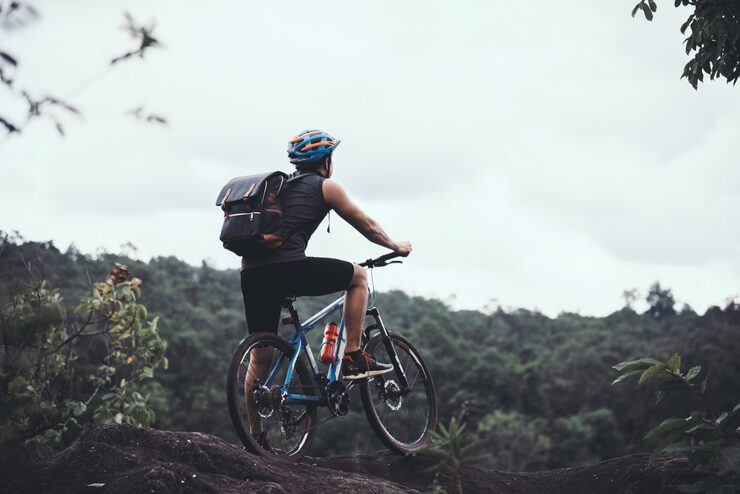

Introduction
Mountain biking has evolved from a fringe off-road pursuit into one of the world’s most popular outdoor sports, with an industry producing thousands of distinct models across a staggering price range from under $500 to above $15,000. The mountain bike buying landscape can be genuinely bewildering for newcomers and even for experienced riders transitioning between disciplines or upgrading after years on a single bike. The decisions you make when choosing a mountain bike — hardtail or full suspension, wheel size, suspension travel, and frame material — determine not just what terrain the bike can handle but how enjoyable your riding will be across the range of conditions you encounter most frequently.
Hardtail vs Full Suspension Mountain Bikes
The most fundamental mountain bike decision is between a hardtail (front suspension fork only, rigid rear) and a full-suspension design (front fork and rear shock). Hardtails are lighter, simpler, less expensive at any given component quality level, and more efficient on smooth or moderately rough terrain where the rear wheel tracks the ground well without the pedalling energy losses that rear suspension can introduce at lower-quality designs. They reward rider technique by requiring more active bike handling over rough terrain and are the preferred choice of many cross-country racers and endurance riders. Full suspension bikes absorb more impact at the rear wheel, improving traction and control on rough, technical, and high-speed terrain — the additional capability comes at higher weight, greater mechanical complexity, and higher cost for equivalent component quality. For beginners and trail riders, a mid-travel (120–140mm) full-suspension bike offers the most forgiving experience; for cross-country fitness riders and those on a budget, a quality hardtail delivers excellent performance and value.
Understanding Suspension Travel
Suspension travel — measured in millimetres — indicates how far the fork and rear shock can compress when encountering impacts. Trail and cross-country bikes typically run 100 to 130mm of travel front and rear — sufficient for most singletrack trail features while maintaining efficiency for climbing. All-mountain bikes at 130 to 150mm cover a wider capability spectrum, handling technical descents while remaining manageable on climbs. Enduro bikes at 150 to 170mm travel are built for aggressive descending and technical terrain, accepting weight and climbing efficiency penalties for maximum downhill capability. Downhill bikes at 200mm and above are purpose-built gravity machines used primarily at bike parks or shuttle-accessed trails. Matching your travel choice to your most frequent riding conditions rather than your most aspirational riding conditions is the most common advice from experienced coaches — a 150mm enduro bike is harder work on the climbs you’ll do 80% of the time to access the descents you enjoy 20% of the time.
Wheel Size: 29er, 27.5 or Mixed
Modern mountain bikes are primarily available in 29-inch, 27.5-inch (650b), and ‘mullet’ (mixed) configurations. 29-inch wheels have become the dominant choice for cross-country and trail riding due to their rollover advantage over obstacles, greater traction contact patch area, and momentum maintenance on technical terrain. The larger wheel does require a larger frame for proper geometry and can feel less agile in very tight, twisty terrain. 27.5-inch wheels offer a snappier, more manoeuvrable feel that some riders prefer for tight technical trails and jumps. The mullet configuration — 29-inch front, 27.5-inch rear — has gained significant popularity as it combines the rollover benefit of the larger front wheel with the tighter rear end geometry that a smaller rear wheel allows, improving both stability and playfulness simultaneously.
Frame Materials: Aluminium vs Carbon Fibre
Mountain bike frames are manufactured primarily in aluminium alloy or carbon fibre, with steel and titanium serving niche segments. Aluminium frames are the dominant material for bikes under approximately $3,000 — they offer good strength, adequate stiffness, reasonable weight, and straightforward repairability at lower cost than carbon. Quality aluminium frames from reputable brands (Trek, Specialized, Giant, Santa Cruz, Yeti) provide excellent performance and durability. Carbon fibre frames are lighter and can be engineered to specific stiffness and compliance characteristics not achievable in metal, enabling better vibration damping and optimised tube-by-tube engineering. Carbon frames become available at approximately $2,500 to $3,000 complete bike pricing and offer genuine performance advantages at the cross-country race and high-end trail levels. For riders who are still developing skills or ride in environments with rock strike risk, aluminium’s tolerance for impact and lower repair or replacement cost is a practical consideration.
Component Groupsets and Brakes
A mountain bike’s drivetrain and braking system significantly affect the riding experience and durability under trail conditions. Modern mountain bikes use 1x drivetrains (single front chainring, wide-range rear cassette with 10 to 12 speeds) that eliminate front derailleurs, reducing mechanical complexity and the risk of dropped chains while providing adequate gear range for most trail climbing and descending demands. Shimano and SRAM dominate mountain bike drivetrain supply, with Shimano’s Deore/SLX/XT/XTR and SRAM’s SX/NX/GX/X01/XX1 tiers providing quality levels from budget-appropriate to race-ready. Hydraulic disc brakes are now standard across all but the most entry-level mountain bikes and provide significantly better modulation, power, and wet-weather performance than mechanical alternatives. Four-piston brakes (Shimano Saint, XT 4-piston, SRAM Code) offer higher power and better heat management for steep, sustained descents; two-piston designs are appropriate for most trail riding.
Frequently Asked Questions
What mountain bike budget should I start with? A meaningful trail-capable mountain bike begins at approximately $1,000–$1,500 for a quality hardtail; full-suspension bikes worth buying start around $2,000–$2,500. Do I need full suspension for trail riding? Not necessarily — a quality hardtail handles most trail conditions effectively and forces better rider technique development. What brand should I buy? Trek, Specialized, Giant, Santa Cruz, and Yeti are well-regarded brands — focus on geometry, component spec, and local dealer support over brand loyalty at equivalent price points.
Conclusion
Choosing the right mountain bike is a process of honestly matching the bike’s capabilities to the riding you actually do, the terrain you most frequently ride, and your current skill level — not the aspirational riding you imagine doing. A well-chosen mountain bike at a modest budget that fits your riding will provide more enjoyment than an over-specified machine that feels unwieldy on your local trails. Test ride whenever possible, read current geometry and component reviews, and invest in a bike that makes your current favourite trails more fun rather than one sized for trails you haven’t yet ridden.